Tape Character and Delay Routing
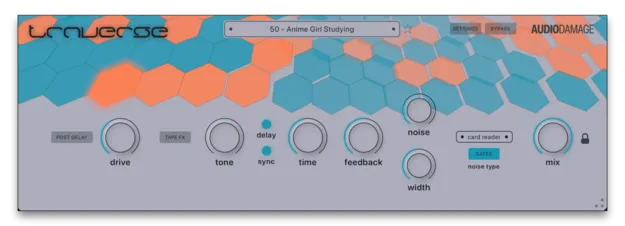
The cassette engine uses a magnetic-hysteresis model that responds to signal history, so saturation changes with what came before it rather than following a fixed curve. Drive moves the tape from clean to fully saturated, and internal gain compensation keeps the output level steady across the sweep.
Wow and Flutter each have their own depth control and LFO, with a noise component layered in. Wow handles slow pitch drift and Flutter handles faster jitter, and the modulation is applied per channel, which gives the stereo image a cassette-like wobble.
With Post-Delay off, the signal runs cassette first and delay second, and feedback passes back through the full tape chain. Turning it on makes the cassette process only the delay tail, which gives a cleaner input path.