Sound Shaping With Ten Saturation Algorithms
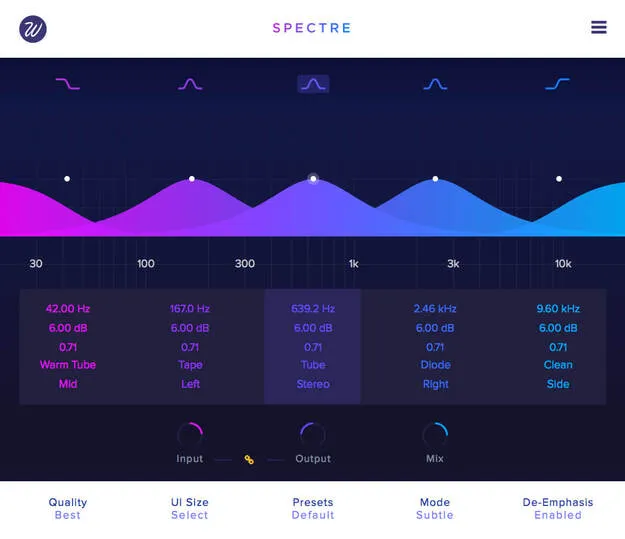
Spectre splits the incoming audio into five parallel bands. It extracts the difference between the processed signal and the dry input, runs that difference through one of ten saturation algorithms, and mixes it back with the dry signal. The available models range from tube and tape styles to diode, class B, bit crushing, digital clipping and rectification modes.
Each band can be set to process mono or stereo signals, only the left or right channel, or only the mid or side channel. The mid/side option is one way to widen a mix at the top end.
A Clean mode turns Spectre into a parallel EQ that does not saturate the difference signal. Three saturation levels (subtle, medium and aggressive) give a quick way to warm up a track, and input and output controls allow finer gain control. A de-Emphasis mode reduces the EQ boost that follows distortion, so you can add harmonics without raising the level of existing content.