How the Physical Model Shapes the Sound
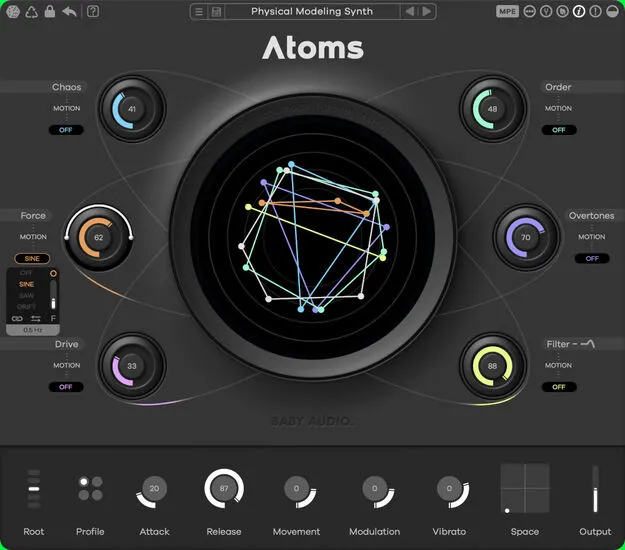
Atoms runs a mass-spring simulation triggered by a virtual bow. The Force control sets the pressure of the bow on the springs, adding noisiness and sharper harmonics as it rises. Overtones moves the bow position along the network, changing how bright the result sounds. Order increases damping, which works much like a low-pass filter, and Chaos adds nonlinear pitch glides and detuning.
Attack and Release also come from the physics of the model. Attack changes how the bow starts, from abrupt to gradual, while Release controls damping, from short decay to near-infinite sustain. The Visualizer shows the nodes and connections in the simulation, so you can watch the network respond as you play.