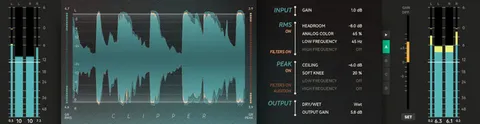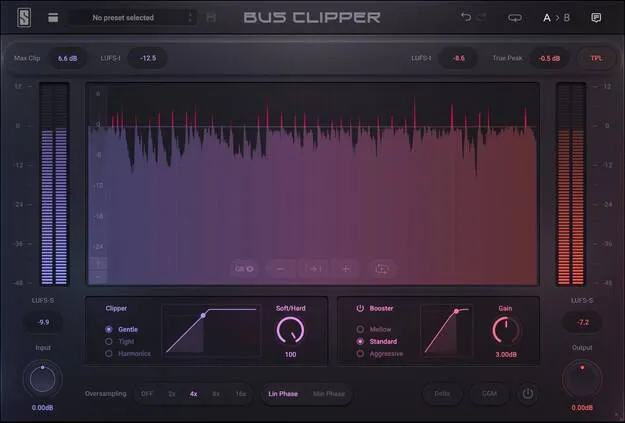
Bus Clipper by Slate Digital clipper plugin interface

Bus Clipper: Two-Stage Clipper and Loudness Plugin by Slate Digital

Rated 4.9/5 on Plugin Boutique (14 ratings)

Bus Clipper is a two-stage dynamics plugin from Slate Digital that clips transient peaks to recover digital headroom and then uses waveshaping to raise perceived loudness. It is built for mastering and bus processing.

VST3VST2AUAAXWindowsmacOS64-bit
AVAILABLE ATPlugin Boutique
Opens the store in a new tab
01Overview

Bus Clipper pairs a sample-by-sample clipper with a separate booster stage. The clipper turns down peaks above a set ceiling and leaves everything below it untouched. The booster raises perceived loudness through waveshaping, lifting quieter parts of the signal while louder parts stay where they are. Slate Digital positions it for the mastering chain, though it can also be used on drum buses, snare tracks and other sources where transient control and level matter.

Best for

  • Mastering chain loudness
  • Drum bus transient control
  • Snare level and clipping
  • Peak headroom recovery
  • Loudness push on mix buses
Developer
Slate Digital
Store
Plugin Boutique
02Key features

What you get

  • Two-stage design: a clipper stage followed by a waveshaping booster stage
  • Three clipping modes with an adjustable Shape/Harmonics control
  • Three booster modes (Mellow, Standard, Aggressive) with a Gain knob
  • Selectable 2x, 4x, 8x or 16x oversampling
  • Linear-phase or minimum-phase downsampling filter options
  • True Peak Limiter at the output to catch overshoots
  • Real-time LUFS-I, LUFS-S and True Peak metering
  • Delta Listen and Constant Gain Monitoring for A/B comparison
03In depth

Clipping Modes, Booster Modes and Oversampling

The Clipper stage offers three clipping modes, each adjustable with a Shape/Harmonics knob. They cover hard clipping, gentle saturation and precision harmonic generation. The Booster stage has three modes named Mellow, Standard and Aggressive, with a Gain knob and a real-time transfer function display that shows the exact curve being applied.

Clipping creates high-frequency harmonics that can fold back into the audible range as artifacts. Slate Digital says its alias-reduction algorithm produces fewer of these harmonics, so 16x oversampling delivers results that other clippers reach only at 256x. You can choose 2x, 4x, 8x or 16x rates and select linear-phase or minimum-phase downsampling filtering. A True Peak Limiter at the end of the chain catches any remaining overshoots.
Metering and Monitoring for Mastering

Bus Clipper includes Integrated Loudness (LUFS-I), Short-Term Loudness (LUFS-S) and True Peak metering that update in real time. A gain reduction style meter shows clipping activity in the same way a compressor or limiter meter does.

Delta Listen lets you hear only the signal being removed, which helps you check what the clipper is doing. Constant Gain Monitoring (CGM) keeps volume steady when you A/B processing, so loudness changes do not bias your comparison.

04Specs

Will it run?

Formats, systems and requirements as listed by Plugin Boutique. Missing details are left out, not guessed.

DeveloperSlate Digital
TypePlugin
CategoryDynamics Processor
FormatsVST3, VST2, AU, AAX
Operating systemsWindows, macOS
Architecture64-bit
05FAQ

Questions, answered

What formats does Bus Clipper support?

Bus Clipper is available in VST3, VST2, AU and AAX formats. It runs on Windows and macOS.

What do I need to run Bus Clipper?

On macOS 13 or later, you need an Intel or Apple Silicon processor and 4GB of RAM. On Windows 10 or 11, you need an Intel or AMD processor and 4GB of RAM. A free iLok license manager account is required to run Slate Digital software.

Can I use Bus Clipper outside of mastering?

Yes. Slate Digital says it works on a drum bus, a snare track or anywhere you need to control transients and increase level.

07Developer

More from Slate Digital

All Slate Digital products →