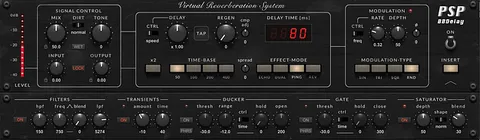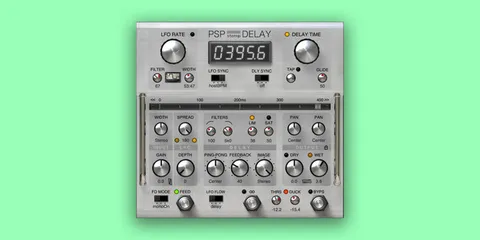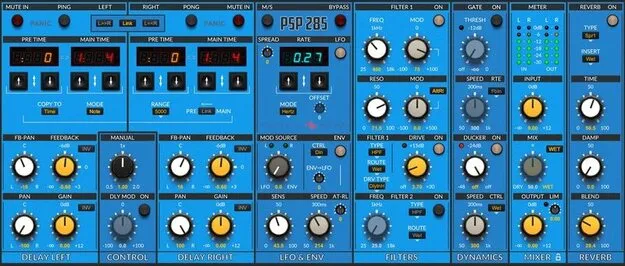
PSP 285 semi-modular delay plugin interface by PSP Audioware

PSP 285: Semi-Modular Delay Plugin by PSP Audioware

Rated 4.8/5 on Plugin Boutique (16 ratings)

PSP 285 is a semi-modular delay plugin from PSP Audioware that produces a wide range of delay-based effects, from simple slapbacks and echoes to rhythmic patterns, tape-style delays and resonant filtered textures.

VST3VST2AUAAXWindowsmacOS64-bit
AVAILABLE ATPlugin Boutique
Opens the store in a new tab
01Overview

PSP 285 is built on the PSP 84 and PSP 85 delay plugins and uses variable sample rate delay lines as its foundation. Its semi-modular design gives you control over how the delay, modulation, filtering, drive and reverb interact in the signal chain. The developer describes it as capable of everything from faithful magnetic tape delay simulations to pitch-shifted and resonant effects, with 64-bit floating point processing throughout.

Best for

  • Tape-style delay effects
  • Rhythmic delay patterns
  • Pitch-shifted delay textures
  • Resonant filtered echoes
  • Send effects with wet mode
  • Mid-Side delay processing
Developer
PSP Audioware
Category
Delays
Store
Plugin Boutique
02Key features

What you get

  • Semi-modular architecture with up to 10 seconds of delay per channel
  • Continuous delay time control and per-channel pre-delay
  • Stereo (L/R) or Mid-Side (M/S) operating modes
  • Delay gating and wet signal ducking for clearer echoes
  • Tempo-synced LFO and envelope follower mixable in any proportion
  • Six click-free LFO waveforms with offset and phase spread
  • 17 filter types with adjustable cutoff and resonance
  • Multi-algorithm reverb with spring, plate, space and reverse modes
  • Mixer settings stored per preset or applied in Global mode
  • Support for sample rates up to 384 kHz and almost 400 presets
03In depth

Delay Engine and Signal Routing

Each channel offers up to 10 seconds of combined pre-delay and main delay time, depending on the internal sampling frequency. Delay time is continuously adjustable, and you can set pre-delay independently for each channel.

Cross-channel feedback and channel link mode let you shape how the left and right sides interact, while delay gating helps control the number and level of echoes. You can work in standard stereo (L/R) or Mid-Side (M/S) mode, and wet signal ducking keeps the processed sound from masking the dry signal.

Reverb can sit at different points in the chain: dry, wet, or a mixed wet and dry output. A wet mode switch is provided for use in sends.
Modulation, Filtering and Drive

The modulation section combines a tempo-synced LFO with an envelope follower, and the two can be mixed in any proportion. The LFO offers six click-free waveforms, variable offset and phase channel spread, and the envelope follower has a range of control signals in linked or unlinked mode.

The filter section includes 17 filter types with adjustable cutoff and resonance and flexible routing. A Drive algorithm can be placed after the filter or routed independently, with hard and soft saturation modes.

The multi-algorithm reverb module includes spring, plate, several space types and reverse, in both mono-to-stereo and dual mono modes.

04Specs

Will it run?

Formats, systems and requirements as listed by Plugin Boutique. Missing details are left out, not guessed.

DeveloperPSP Audioware
TypePlugin
CategoryDelay
FormatsVST3, VST2, AU, AAX
Operating systemsWindows, macOS
Architecture64-bit
05FAQ

Questions, answered

What formats does PSP 285 support?

PSP 285 is available in VST3, VST2, AU and AAX formats.

Which operating systems does PSP 285 run on?

PSP 285 runs on Windows and macOS. On Windows, the listed requirements cover Windows 7 through Windows 11. On macOS, the listed requirements cover macOS 10.12 through macOS 13 Ventura, with Apple Silicon supported.

What do I need to run PSP 285?

The latest iLok License Manager application must be installed on your computer.

Is PSP 285 a 64-bit plugin?

Yes. PSP 285 uses a 64-bit floating point signal path.

07Developer

More from PSP Audioware

All PSP Audioware products →