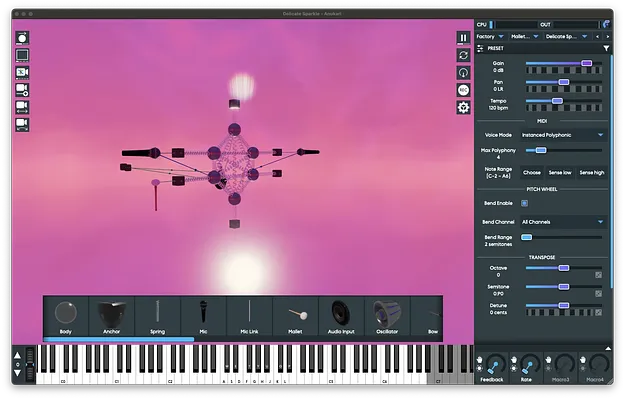
Anukari 3D physics synthesizer plugin interface showing masses and springs in a 3D world

Anukari: 3D Physics Synthesizer and Effects Processor

Anukari is a software synthesizer and effects processor built on a real-time 3D physics simulation, where you build instruments from masses, anchors and springs and play them with MIDI or process audio through them.

VST3AUAAXStandaloneWindowsmacOSLinux64-bit
AVAILABLE ATPlugin Boutique
Opens the store in a new tab
01Overview

Anukari takes a different approach to sound design. Instead of shaping a waveform with familiar oscillators and filters, you construct a physical object in an interactive 3D editor, connect its parts, and excite it to hear how it responds. The simulation runs at audio sample rate, so the structures you build ring, vibrate and interact in real time, and you can watch them move as you play. It works as a MIDI instrument, an audio effects processor, or both at once, and it ships with over 200 factory presets to start from.

Best for

  • Experimental sound design
  • Organic textures and pads
  • Flute-like sustained tones
  • Leslie-style rotating effects
  • Audio-reactive live visuals
  • Multichannel ambisonic installations
Developer
Anukari
Category
Synths
Store
Plugin Boutique
02Key features

What you get

  • Real-time 3D physics simulation running at audio sample rate
  • Synthesizer and effects processor in one plugin
  • Five excitation types: mallets, plectrums, bows, oscillators, audio
  • Directional virtual microphones with built-in compressors
  • LFOs from 0.01 Hz to 20 kHz with recursive LFO routing
  • Visual modulation matrix drawn in 3D space
  • Full MPE support and MTS-ESP microtuning
  • Over 200 curated factory presets
03In depth

Sound Design Through Physical Simulation

Anukari's instruments are built from masses, anchors and springs placed in a 3D world. You excite them with one of five sources: mallets for directional impacts, plectrums for plucked and released tones, bows for sustained, flute-like harmonic tones, oscillators with ADSR envelopes, or external and internal audio signals that can be gated by MIDI.

Directional virtual microphones pick up the result, each with a built-in compressor. Modulating their rotation gives Leslie-style effects, and routing microphones back into the physics system through modulatable delay lines creates feedback loops.

Because the simulation is the sound source, results can range from subtle organic textures to large, evolving systems built from hundreds of objects.
Modulation and Workflow

Modulation is deep. LFOs run from 0.01 Hz up to 20 kHz, which reaches audio-rate FM territory, and LFOs can modulate other LFOs. MIDI-triggered envelopes, envelope followers and every MIDI control source, including velocity, pitch bend, CC, pressure and aftertouch, can drive nearly any parameter. DAW automation can be mapped as well.

The visual modulation matrix draws connections as lines in 3D space. You drag from a modulator to a target, and every routing stays visible in the scene. Full MPE support and MTS-ESP microtuning are included.

For multichannel work, Anukari handles up to 50 inputs and 50 outputs, so each microphone can go to its own DAW bus or feed an ambisonic dome.

04Specs

Will it run?

Formats, systems and requirements as listed by Plugin Boutique. Missing details are left out, not guessed.

DeveloperAnukari
TypePlugin
CategorySynth
FormatsVST3, AU, AAX, Standalone
Operating systemsWindows, macOS, Linux
Architecture64-bit
05FAQ

Questions, answered

What formats does Anukari support?

Anukari is available as VST3, AU, AAX and a standalone application. It runs on Windows, macOS and Linux.

What do I need to run Anukari?

On Windows and Linux you need Windows 10 or later, or a 64-bit x86 Linux system from 2022 or later, with a CPU from around 2015 or newer that supports AVX2 and a GPU with Vulkan support. On macOS you need macOS 12 or later on Apple Silicon or an Intel Mac from around 2015 or newer with AVX2. Each platform needs 1 GB of free disk space.

Can Anukari process audio as well as play MIDI?

Yes. It can be used as a MIDI instrument, an audio effects processor, or both at once.